This meme is bouncing around the internet and it needs pulling apart —
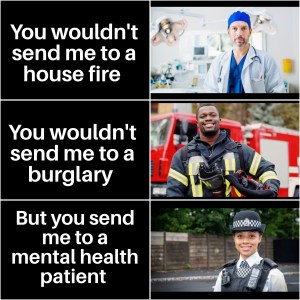
Right, this shouldn’t take too long —
- Doctors do go to some house fires – occupants can be injured and in need of pre-hospital care. Burns, smoke inhalation, cardiac arrest arising from both and I can give you an example of an inquest where this involved a mental health patient and the police were there, too – but not to deal with the house fire.
- The doctor is not there to deal with the house fire, either – just some of the wider issues which exist around it.
- Firefighters do go to crime scenes and not just arson – victims and suspects can find themselves in situations where they need rescue services arising from the crime and I can think of two burglaries (inc one aggravated burglary) where the fire service turned up because suspect was in need of rescue after trying to escape and getting in to high levels of danger at height, and a victim who had been taken at knife point to a balcony of a flat in a multi-storey.
- The firefighters were not there to deal with the burglary, just some of the wider issues which exist around it.
Can you tell where I’m going with this?!
- Police officers are sometimes correctly sent to deal with “mental health patients” –
- Some situations involving mental health patients involve crimes, immediate risks or questions of law and liberty which may require police powers, for example to enter premises.
- The police officer is not there to deal with the mental health patient, just the context or some of the wider issues which exist around them.
- Once you have, you handover the substantive issue to those more appropriate to deal with it and leave. Yes – I do realise this can take far too long to achieve.
And all of this before we even start to critically analyse whether the things immediately labelled as ‘mental health’ calls are in fact, calls about one of us with mental health problems, rather than calls arising from people in real distress arising from life and its many, complicated problems. This stuff shouldn’t really still need explaining but in recent times we’ve seen a lot of overly simplistic propaganda swinging in to view, like this meme – this is just the latest example.
HEALTH and JUSTICE
Let’s never forget: the police ask mental health services to deal with people who break the law all the time and yet we don’t see nurses circulating memes on social media asking why we send them to “deal with criminals” – they know it’s more complicated than that.
In another kind of example recently, a video on social media about policing and mental health released by the College of Policing involves a senior officer quoted as saying, “We’re talking about people who are ill here. They’re not bad. They’re not criminals.” Well, you don’t have to try very hard to see that many ‘mental health’ incidents to which the police are called do involve people in crisis who have transgressed criminal law – and at both ends of the offending spectrum. They also involve people who may appear mentally ill, even acute so, but either aren’t – or they have social problems leading to distress made worse by substance (ab)use. This stuff is not always an ‘either’ / ‘or’ proposition.
All people are individuals – all situations turn on their specific circumstances.
Only today, we learn of a new Independent Officer for Police Conduct (IOPC) investigation in to contact in Nottingham prior to last year’s three killings and another three attempts, to examine police contact, including conduct in the homicide investigation. This example does involve both ends of that spectrum: because prior to commission of the most serious crimes, there was repeated accusation of criminal damage and assault leading to arrests for those things and assessments under the Mental Health Act 1983. We heard all about his mental health during sentencing but his responsibility in law for homicide was “diminished”? – well yes, but he still killed three people and tried to kill three others and now, he’s a convicted criminal.
There is no easy dividing line – and nor is there actually a need to have one, either.
What we know about investigation of incidents where transgressions have occurred is they often involve diversion from justice in circumstances where it may or may not be the correct thing to do – presumably that’s what the IOPC might be looking at, given police contacts with Mr Calocane in the years before. Sometimes situations move forward to court, other times they don’t, but there is no easy dividing line to say which should be which and we know the police will sometimes push to characterise obvious crimes as ‘mental health crisis’ – and I’m not saying they’re always wrong to do so, but we do know they’re not always right, either.
There’s no point pretending a psychotic patient threatening people in response to their auditory hallucinations isn’t also causing risk that needs police management and consideration of investigation for the crime it amounts to, even if only briefly. So I’ll say this again: Professor Jill Peay pointed out quite correctly and in detail in her book Mental Health and Crime (2010) how work done at the interface of mental health and criminal justice is amongst the most complicated to be done by any professionals from either health or justice. This is such an important point, it’s been on the front page of this website for years.
RISK OF OVER-SIMPLIFICATION
As such, the reality of this work is resistant over-simplification such as the meme, above or the attempt to artificially carve the world in to ‘illness’ and ‘crime’. I’ve spent years writing this blog to point out, amongst other things, that pushing to over-simplify in this way is what makes things go awry, on occasion. Let me say that again so you know I mean it: attitudes which sit behind these examples, which pretend that crime and illness are distinct and which over-simplify the police role, is literally what helps make things go wrong – and Coroner’s or criminal courts have had to untangle this stuff for us in the past.
As many population-level drivers of illness and crime are broadly similar, we need to see the overlaps much more deeply — poverty, housing, education, (lack of) employment, family breakdown, discrimination, etc., and life expectancy is affected accordingly. Criminals are often quite ill (not just mental health) and mental health patients are often criminalised. For all that may be regrettable, it is also occasionally very necessary, given the legal and social systems we operate – and there’s the paradox in your system.
Two final points about the meme of police going to mental health patients —
- Much of what is labelled ‘mental health’ by the police is not severe and enduring mental illness — it is severe social or situational distress.
- We can and should be discussing the extent to which it is the role of our specialist mental health system to be leading responses to that because that’s not what it’s for (and crucially, it’s certainly not what it’s resourced for – and it never was).
- Some senior psychiatrists believe that most people living in the UK with mental illness are receiving no treatment because they haven’t presented to their GP or to other services where needs can be identified and met.
- So the ‘patients’ referred to often do present in the first instance to the emergency system – not just to the police, but also the ambulance service and Emergency Departments. It would be weird if it were otherwise.
Try not to be taken in by the tendency to over-simplify complex situations, involving vulnerable people at the juxtaposition of ‘health’ and ‘justice’ and remember there’s no obvious dividing line – there never was.
They can and they do overlap – that’s an inherent part of the law and our system of responses.
Winner of the President’s Medal, the Royal College of Psychiatrists.
Winner of the Mind Digital Media Award


All opinions expressed are my own – they do not represent the views of any organisation. (c) Michael Brown, 2024
I try to keep this blog up to date, but inevitably over time, amendments to the law as well as court rulings and other findings from inquests and complaints processes mean it is difficult to ensure all the articles and pages remain current. Please ensure you check all legal issues in particular and take appropriate professional advice where necessary.
Government legislation website – www.legislation.gov.uk

 Mental Health Cop