An inquest in Northern Ireland is has spent the last few weeks wading its way through the very sad events which led to a double killing in Portadown in 2017. Thomas McEntee pleaded guilty in 2018 to the manslaughter of Michael and Marjorie Cawdery on the grounds of diminished responsibility and was sentenced to ten years in prison. He is now detained in a secure psychiatric unit (presumably, having been transferred there from prison under the Northern Ireland Mental Health Order 1986). An inquest sitting in Antrim has spent several days listening to difficult and contradictory evidence which included various NHS and police contacts in the days prior to Mr and Mrs Cawdery’s deaths.
The couple, in their 80s, were killed in their own home on 26th May 2017 after they returned from a shopping trip. To compound the tragedy still further, they were discovered by their family who lived next door. It’s heartbreaking just to read about it, never mind life through it as their family has done, attending the inquest every day. My heartfelt condolences to them all.
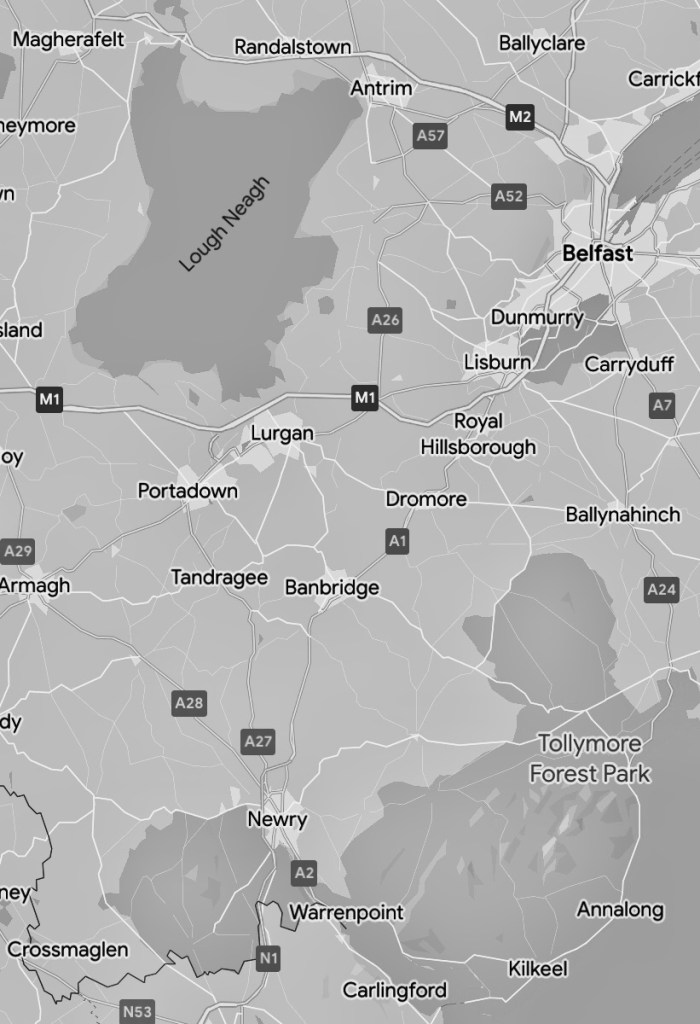
For those who may be unfamiliar with the geography covered in explaining the events, there is a map of the relevant part of Northern Ireland at the bottom of this post but: Portadown is around 30-miles south-west of Belfast, just south of Lough Neagh; and Newry & Warrenpoint are 20- and 25-miles south of Portadown, near the border with the Republic of Ireland.
TIMELINE
The main events reported in the media coverage appear to be —
- 22nd MAY 2017 – Belfast
- Mr McEntee attended a police station in the city centre to complain about being followed. Officers who spoke to him felt the nature of his complaint was attributable to concerns they had about his mental health.
- They contacted his sister in Derry who agreed to come and collect him but he left the police station before she arrived.
- He was found a short time later by his sister who called the police again and he was assisted to Mater Hospital in Belfast.
- The inquest heard contradictory evidence from Dr Melissa King and PC Hugh Gibson about how the risk posed by Mr McEntee was perceived – the police claimed some relevant risks were not documented but were mentioned verbally on handover, with NHS staff denying this.
- All of this confusion or contradiction contributed to acknowledgements things may have been done differently if everyone had known of factors claimed to have been mentioned by the police.
- 24th May – Daisy Hill Hospital, Newry
- Mr McEntee attended Daisy Hill without an appointment, asking for medication. The healthcare trust covering that part of Northern Ireland held no information about Mr McEntee and they contacted their local crisis team.
- All of the staff on the crisis team were busy and it took 45mins to get in touch with someone.
- After waiting an hour and a half, he left without being seen but returned 4hrs later to the Accident and Emergency department.
- Mr McEntee told the ED doctor he was known in Derry and that his history would be known there but that he’d not taken medication for three days and was unable to keep himself safe.
- The doctor rang the mental health team at Craigavon Hospital and a senior mental health nurse said they’d contact the trust who knew him and then come back to them.
- The doctor believed a mental health assessment was required because of suicidal ideation and Mr McEntee had self-injured that day.
- When Craigavon returned the call, they had decided – without seeing mr McEntee – that assessment was not required because suicidal ideation was ‘chronic’ and that he could be discharged and the team would follow him up the next day.
- The doctor maintained that a mental health assessment was required but when asked by the coroner whether she had ‘pushed back or debated’ the decision, she replied that ‘experience and expertise’ in the mental health had influenced the decision.
- Mr McEntee was asked to provide a phone number so he could be followed up – but he had no phone. Homeless accommodation was arranged by a social worker and he left the ED.
- 25th May, Warrenpoint
- On 25th May, police in Warrenpoint (south of Belfast) were called to Mr McEntee when concerns were expressed about his behaviour, including intoxication.
- They assisted him to a train station to enable him to get home, but it later became known he hadn’t boarded a train.
- Those officers who met Mr McEntee and took him to the station stated in evidence they weren’t aware that the behavioural complaints had included suggestion of women being harassed or pestered prior to the police being called.
- 26th May, Newry
- The following day, police were called to reports of a naked man walking close to the train station in Newry and several police officers were deployed.
- Police were handed Mr McEntee’s clothes by a member of the public who’d found them, and it contained identification, before they then discovered he’d walked in to Daisy Hill hospital where he was encountered by security guards.
- Having been brought outside the hospital by security, Mr McEntee was reported to have adopted a “fighting stance” before force was used to take him to the ground.
- Mental health staff from Daisy Hill came outside whilst this was ongoing and it was decided he should be taken by ambulance to Craigavon Hospital where he could potentially be admitted to a mental health unit.
- 26th May, Craigavon Hospital & Portadown
- The police followed the ambulance from Newry to Craigavon and upon arrival, officers asked if they were required to stay there.
- The inquest heard that paramedics stated the police would not be needed and he was taken in to the Emergency Department for assessment. During the process where a nurse took blood, he pulled out the needle and walked out. He then stole a bottle of wine from a hop before breaking in to the Cawdrey’s home.
- The ED nurse stated in evidence that she was not fully briefed by the ambulance service and wasn’t made aware in the verbal handover that police officers had been involved in restraining Mr McEntee.
- She stated that had she known that, she would have expected the police to remain with him.
- She further stated that when Mr McEntee went to leave the department, she had no choice but to let him because “only the police can restrain someone”. She then complied with the trusts absconding policy and reported his walkout.
- Mr McEntee was arrested in a field near the Cawdery’s house after the killings.
The Cawdrey’s relatives have stated he should have been taken seriously when he sought help and they view him as a victim as well, having attempted to get help when he was very unwell.
LEGAL DETAILS
The inquest on its third day started hearing evidence from police officers. It was reported that during the incident outside Daisy Hill hospital on the day of the killings, Mr McEntee was handcuffed but not arrested (either for an offence or detained under mental health law). The coroner has heard evidence there was confusion at the scene about who was in charge – obviously the police had the man under their physical control, but it was ostensibly in connection with a crisis incident where mental health staff were present and an ambulance had been called. This has been known before where the potential for legal power to be in play mean NHS staff assume a police lead, but the incident being a mental health crisis incident, at least ostensibly, means the police assume leadership needs to be clinical by NHS staff. In reality, both views are correct and this is why communication is absolutely key – as we’ve seen before.
The legality of the decision to detain, restrain but not arrest has been dissected in the inquest proceedings: Article 130 of the Mental Health (Northern Ireland) Order 1986 allows a constable to detain someone and remove them to a Place of Safety for assessment – exactly analogous to section 136 MHA in England and Wales or section 297 of the MHA in Scotland. This power was not invoked and nor was Mr McEntee arrested for an offence. Officers in evidence agreed that criteria for use of article 130 were met, but the power was not invoked. Evidence has been heard the Police and Criminal Evidence (Northern Ireland) Order 1989 covers this. I must admit: I don’t know where that is covered.
So this inquest ends up touching upon an issues we’ve covered on this blog before, more than once, albeit I’m not sure I recall any similar events to this in Northern Ireland itself —
- Whether and when mental health law should be invoked to safeguard someone in crisis.
- Whether to assist someone on a voluntary basis to hospital, esp if their capacity to consent to assistance may be in question or whether they will remain in a safe setting for assessments to conclude.
- Hospital walkouts where people are under no obligation to remain but where there is concern amongst NHS staff arising from someone’s decision to leave against advice.
- Communication between agencies – including around primacy of decision-making.
So again, we heard after the conclusion of the inquests that organisations will look at the findings from the Coroner’s courts and ensure that lessons are learned, with hopes to ensure nothing like this can happen again. This is fairly standard stuff after a critical inquest finding. The problem being: we’ve seen his before (albeit in other areas) and it speaks towards my previously voiced concern about ensuring lessons are learned more widely than the directly affected organisations. If police force X has a tragedy which involved mental health trust X or ambulance service X, will police force Y ensure the lessons are learned, given they were unaffected – and in particular, will they ensure those lessons are learned by mental health trust Y and ambulance service Y? This is what has often been missing and this inquest shows it again.
His Majesty’s Coroner has now indicated she will spend time reviewing the evidence of more than 40-witnesses before reaching her conclusion and I will cover that outcome, once it becomes known. We can see how important these issues are here, given the number of contacts Mr McEntee had with the state in the days, indeed the hours, prior to the Cawdrey’s tragic deaths in the place they should have been safest of all – their own home.
Winner of the President’s Medal,
the Royal College of Psychiatrists.
Winner of the Mind Digital Media Award


All views expressed are my own – they do not represent the views of any organisation.
(c) Michael Brown, 2023
I try to keep this blog up to date, but inevitably over time, amendments to the law as well as court rulings and other findings from inquests and complaints processes mean it is difficult to ensure all the articles and pages remain current. Please ensure you check all legal issues in particular and take appropriate professional advice where necessary.
Government legislation website – www.legislation.gov.uk

 Mental Health Cop