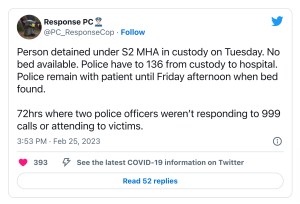
 A post in response to this tweet from a police officer in the United Kingdom —
- Firstly, the person was not detained under s2 on Tuesday – all that happened that day was an assessment with a decision taken to seek admission.
- It’s worth noting there are arguments around from some lawyers it’s not legal to use s136 from custody after a Mental Health Act assessment has occurred – it’s not an argument I agree with and contested by plenty of other lawyers, but worth mentioning in passing.
- Even if s136 MHA were used from custody, the power arising from it lasts for 24hrs (until the Wednesday in this example) so it’s worth wondering what legal powers the police were relying upon on for Thursday and Friday until the MHA application was made to eventually admit the person under s2 MHA?
- It’s also worth mentioning: a 72hr delay to find a bed is by no means the longest I’ve heard about or that we’ve seen reported – some delays last weeks.
The replies to this tweet are very interesting as well, because it reinforces how the points I’ve just made, above, are not widely understood.
- One commentator stated that after MHAA assessment the person is only ‘liable to be detained’ – this is not correct.
- Liable to be detained means the MHA application has been made (at which point s6 MHA allows the AMHP to ‘take and convey’ the person to hospital).
- Another respondent stated that the person detained under s136 was “already at a Place of Safety so how can you 136 at a Place of Safety?”
- Nothing in law prevents use of s136 MHA where someone is already at a Place of Safety – officers use s136 MHA in A&E all the time, for example. Section 136(1)(b) expressly states the power can be used to keep someone at a Place of Safety.
- A practising AMHP commented on the officer’s tweet, pointing out some of the misunderstanding with the hashtag #AMHPlife and asking about section 140 MHA?
I would argue that it’s at least in part because of the fact officers are unaware of some of these MHA basics that they often don’t realise the legal quagmire they’re in. In this situation, the assumption was made that s2 MHA kicked in after the MHA assessment in custody and it seems reasonable to wonder whether it was known that police powers after use of s136 MHA ran out after 24hrs? Yes, s136 can in some situations be extended to 36hrs, but firstly, the same objection could prevail because the subsequent detention lasted three days; and secondly, you can’t extend s136 MHA at all once the MHA assessment has been completed, as was the case here.
We need to understand what it means when we say someone has been ‘sectioned’.
ROOT OF THE PROBLEM
The problem here is not the police, the problem is the obvious difficulty faced by AMHPs in making applications in a timely way. This situation has been occurring for decades and its frequency has been increasing, in my opinion. If you’re interested in what has been done to examine this and encourage change, the Royal College of Psychiatrists ran a commission of inquiry in 2015 which looked at this. As well as reporting a large reduction in the number of inpatient beds against a rising number of people being referred to specialist mental health services, they also concluded that some areas were better than others at balancing the necessary inpatient services (beds) against community mental health teams which can support people outside of hospital. But of course, the stresses and strains of austerity, pandemics and public sector settlements all conspire to mean that these problems are worse now than before, even if the problems themselves are far from new – there have always been delays of this kind, going back decades.
And they were unlawful then, as well.
Use of section 136 MHA after a period in custody under arrest involving a MHA assessment, became a solution of a kind to a particular problem that shouldn’t have existed at all. The BBC reported in 2021 on an unpublished Cabinet Office research report completed a few years before on unlawful detentions in police custody – it was estimated between 3,900 to 4,500 unlawful detentions in police custody took place each year, because of a lack of mental health beds and in feeling morally obligated to keep people safe until a bed was found, police custody was the improvisation of choice.
THE LEGAL FRAMEWORK
The law on this is fairly clear, however –
- Section 13 MHA relates to the duty of AMHPs everywhere to make applications for MHA admission when the grounds for doing so are met – those grounds make no mention of ‘beds’, specifically.
- You are legally not admitted to a bed, but to hospital – to make a police analogy, after someone is arrest, you don’t take them in legal terms to a cell – you take them to a police station. Just as you can arrest someone and take them to a police station without placing them in a cell, you can ‘section’ someone and remove them to a hospital.
- Both locations have to be willing to accept the person and could refuse, but such a decision would need to take account of the context and implications of that decision – if someone is a violent risk to others, better to have them under arrest in a holding area or at liberty?
- If someone is suicidal, better to apply for s2 admission to a hospital with a Place of Safety and hold them there until the bed is found? … you decide. Such action is lawful, even if it’s not ideal best practice and in response to the officers, AMHPs are agreeing this is a legal and practical solution to the problem.
- Section 140 MHA relates to the duty of Integrated Care Boards to specify those hospitals in their areas which can receive patients in circumstances of special urgency and that list should be shared with the AMHPs’ local authority, for situations where applications have to occur.
- The Local Authority, the NHS and the police all have duties under s6 of the Human Rights Act 1998 to ensure the European Convention Rights of those of us whose lives are affected by our mental health.
- To fail to admit someone in an appropriate, timely way is to risk one of several outcomes which would breach the duty – Article 2 (the right to life), Article 3 (inhumane or degrading treatment) and Article 5 (the right to liberty) are all engaged by these situations and this is not hypothetical:
In various cases of failing to admit someone in a timely way, coroner’s have had to facilitate Article 2 inquests with a jury to examine state failures. In the case of MS v UK (2012), one NHS trust was found to have violated the rights of a vulnerable man who had been in police custody for over three days, by failing to ensure his timely admission to a hospital, once it was identified as necessary. Of course, detaining someone in the circumstances of the original tweet, above is an potential Article 5 violation because despite it being a qualified right to liberty which the state can interfere with, they can only do so in accordance with domestic law. Section 136 does not allow for three days of detention after a Mental Health Act assessment.
So we can keep discussing these examples which occur thousands of times a year in various ways that violate rights and fail to ensure responsibilities are discharged, we can argue about the detail of the various improvisations we hear about when the intended process fails and once we’re done with all of that, we’ll come back to the fact that we do not have the correct provision of mental health services for the task in hand and the police service along with the ambulance service and the wider emergency and criminal justice systems (including prisons) are picking up the consequences, at far greater cost than would be the case, both in terms of human life and money. It’s probably just cheaper to do it properly.
The problem here is not the police: the problem is the extent to which we over-rely on the police as a de facto crisis and emergency mental health care provider.
Winner of the President’s Medal, the Royal College of Psychiatrists.
Winner of the Mind Digital Media Award


All opinions expressed are my own – they do not represent the views of any organisation. (c) Michael Brown, 2023
I try to keep this blog up to date, but inevitably over time, amendments to the law as well as court rulings and other findings from inquests and complaints processes mean it is difficult to ensure all the articles and pages remain current. Please ensure you check all legal issues in particular and take appropriate professional advice where necessary.
Government legislation website – www.legislation.gov.uk

 Mental Health Cop